
The Stories We Need to Tell: How Red Rocks Credit Union Makes Storytelling Intentional
Posted by Alyse Knudsen on August 19, 2026

Credit unions have a story to tell.
The challenge, according to Darius Wise, President and CEO of Red Rocks Credit Union, is that the industry hasn’t always been very good at telling it.
“One of the underleveraged strengths of our industry is telling the story that differentiates us,” Wise said. “I think we don’t do a good job at sharing our key differentiator, and that’s who we are as an institution.”
That differentiator is simple: People Helping People.
Credit unions exist to serve their members — not shareholders — and that creates a fundamentally different relationship between a financial institution and the people it serves. But simply having that difference isn’t enough.
Credit unions have to show it.
For Wise, storytelling is becoming an increasingly important part of that work, both at Red Rocks and across the broader Credit Union Movement. And he believes the industry has an opportunity to be much more intentional about capturing the stories that demonstrate its impact.
Start with the mission
Wise’s perspective on storytelling is closely tied to his perspective on mission.
In a recent CU Times opinion piece, he argued that a credit union’s mission isn’t proven by what appears in a vision statement or annual report. It’s demonstrated in the decisions an organization makes when doing the right thing isn’t necessarily the easiest or most profitable choice.
Those decisions create stories.
At Red Rocks, Wise said the leadership team has spent the past several years focused on three strategic objectives: becoming an employer of choice, delivering an exceptional member experience and achieving organic growth.
The order matters.
“If we’re gonna do that, then we’ve gotta have a high-performing, highly engaged workforce,” Wise said of the connection between its culture and member experience.
That is where storytelling comes in. Employees who live the credit union’s values create the experiences that ultimately define the organization. Capturing those moments gives the organization a way to reinforce its culture internally — and communicate its difference externally.
Making storytelling intentional
Earlier this year, Wise and other credit union executives were discussing the importance of telling the credit union story when they recognized a problem: There was no real framework for doing it.
“We left the meeting with a charge, basically, to create structure and framework around storytelling, and more importantly, incentive around storytelling internally, so that we could capture and deploy stories more intentionally,” Wise said.
The result at Red Rocks is “Above and Beyond,” a quarterly employee recognition program designed to celebrate employees who go the extra mile for members, colleagues, and the community.
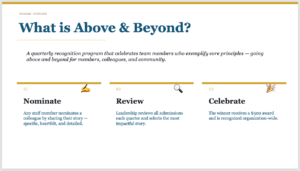
Employees can nominate coworkers by sharing a specific example of how they demonstrated one of Red Rocks’ core values through their actions and the positive impact those actions created.
The program is about recognition, but it is also about something bigger: creating a steady stream of stories.
Each quarter, a senior leadership team selects a winner. That employee receives a $500 award and, importantly, gets the opportunity to share the story in greater depth with the leadership team.
Wise sees that interview as an important part of the process.
“Hearing from them in real time gives us much more context around the impact, and really the motive behind their actions,” he said. “Which I think enriches the impact of the story.”
The stories will also live on Red Rocks’ intranet, creating what Wise describes as a kind of “Wall of Fame.”
For new employees, those stories can become examples of what the organization’s values actually look like in practice.
“They’re gonna see all of these stories about impact,” Wise said. “And what that says to them is that this is what right looks like. This is what great service looks like.”
Building a “rolodex” of impact
There is another benefit to the approach: It gives Red Rocks a library of real stories to draw from.
“Most of us don’t have this backlog of stories that we can tell,” Wise said. “Well, this equips our marketing team to tell the story with intention.”
Instead of searching for a compelling member experience or employee example when a marketing opportunity arises, the credit union can draw from a growing collection of stories.
That could mean a story about member impact. A story about an employee helping a colleague. A story about an extraordinary member experience. A story about what it is actually like to work at Red Rocks.
The goal is to make storytelling part of the culture rather than something that happens only when marketing needs content.
Wise believes the process can eventually become routine: Employees sharing stories in team meetings, managers asking about moments of impact and employees recognizing one another for the work they are doing.
“It’s an iterative process,” he said. “I think we’re going to be shocked by how intentionally we start sharing. We create a culture where storytelling is a part of what we do versus this thing that happens on special occasions.”
The stories are already there
For Wise, the need to tell these stories is particularly important because credit unions cannot — and should not try to — compete with the largest financial institutions on their scale or resources.
They can compete on something else.
Recently, Wise sat down with two Red Rocks founding members who have been with the credit union for more than 47 years. When he asked why they had stayed members for so long, their answer was simple.
“We feel seen and known by Red Rocks,” they told him.
For Wise, that was the kind of story that captures the credit union difference.
“If we don’t tell that story, if we don’t tell stories about customer loyalty and member loyalty, and why people have banked with us for so long, then we don’t differentiate,” he said.
A large financial institution may have more resources, more branches or a bigger marketing budget. But a local credit union can tell the story of knowing a member for decades. It can tell the story of helping someone through a difficult financial moment. It can tell the story of an employee who stayed late, made the extra call or found a solution that went beyond what was expected.
Those moments are the proof behind the mission.
Grab the megaphone
Wise is also looking beyond Red Rocks.
The credit union has joined Backbone, a national effort designed to amplify the voice of credit unions. Red Rocks is also investing in social media, public relations, media partnerships and other platforms to tell more stories about its impact.
For Wise, the strategy is straightforward: The industry already has the stories. It needs to become more intentional about telling them.
His advice to other credit unions is equally straightforward.
“Just start.”
Credit unions don’t need a perfect program, a massive budget, or a fully developed storytelling strategy on day one. They can start with one story, one employee recognition, one member experience, or one conversation in a staff meeting.
“Create a framework, establish an incentive, share it, and just start somewhere,” Wise said.
Because every credit union already has stories that demonstrate its mission.
The opportunity is to find them, tell them, and make sure more people hear them.
As Wise puts it, if credit unions are going to grow and differentiate themselves, they have to be able to tell their story more effectively.
The story is there.
It’s time to tell it.
Posted in Colorado, Leadership, Regional Member News, Storytelling, Thought Leadership, Top Headlines.


















Brittanie Bonanzino
AVP, Communications
Washington
Phone: 509.218.1192
Toll-free: 800.995.9064

Alyse Knudsen
Manager, Communications
Oregon
Phone: 971.450.5660
Toll-free: 800.995.9064

Madlynn Schreibvogel
VP, Public Relations
Colorado
Phone: 303.513.3765
Toll-free: 800.995.9064