
Texas Credit Union Using Smart ATM Strategy to Test Markets Before Betting Millions on Branches
May 13, 2026
By Ray Birch, Dolphin Debit Access
At the $230-million Capitol Credit Union, that question has produced a strategy that looks deceptively simple but carries big implications for growth-minded cooperatives: instead of committing millions upfront to land and construction, the organization is using off-premise, deposit-enabled drive-up ATMs as a way to extend its footprint into new markets, serve members immediately and, perhaps most importantly, test whether a future branch is truly warranted.
As Pierre Cardenas, Capitol Credit Union’s President and CEO, put it, “We needed a way to expand in new markets, and as a $230-million credit union, it’s very difficult to invest the kind of dollars that it takes to build a branch.”
Cardenas said the economics of traditional expansion in the Austin, Texas, market can be brutal.
“Land alone in our environment should cost anywhere from $3 million to $3.5 million just for the piece of plot, let alone building and everything else that comes with it,” he said.
At the same time, members kept sending a clear signal: they still wanted drive-thrus.
“Our members are constantly asking us for drive-thrus,” he said. “They’re just saying, ‘When are you going to put the drive-thru here? I want a drive-thru here, I want a drive-thru there.’”
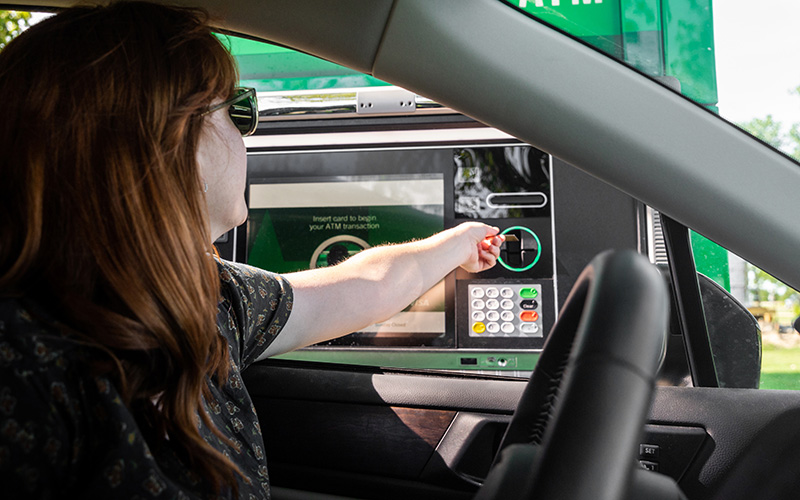
Rather than dismiss that demand, Capitol Credit Union treated it as a market insight — and, partnering with Dolphin Debit, began deploying what Cardenas calls off-premise depository drive-up units in high-growth areas where the credit union lacks a branch presence.
Real-World Market Probes
 The strategy is more than a convenience play. For Capitol Credit Union, the machines function as real-world market probes. By tracking transaction volume — especially deposits and other “monetary transactions” — the credit union can gauge whether member density and usage in a given corridor justify a permanent brick-and-mortar investment.
“We can test the market, see the amount of transactions and especially monetary transactions from the deposit side in order to determine the growth and the activity in these markets,” Cardenas said. “Then we can say, ‘Hey, this one’s grown by so much — this is one that we definitely want to consider putting a branch in because of the density of our membership in this location and it’s continuing to grow.’”
In other words, the ATM is not just an access point; it’s a branch feasibility tool, he said.
That approach has been strengthened by a member-experience twist Capitol Credit Union believed was essential. Cardenas said one of the biggest reasons consumers still favor teller lines and drive-thrus is simple: they want confidence that a deposit — especially a large check — will be available quickly. To address that, the credit union built an internal program, tied to member tenure, balances and transaction history, that can grant immediate credit on larger deposits for low-risk members.
“They want the credit for it right,” he said. “They don’t want holds on it… We needed to avoid that to make these depository units that much more attractive.”
Working with Dolphin Debit, Capitol Credit Union extended that logic into the off-premise ATM channel, allowing members in some cases to deposit a $5,000, $7,000 or even $9,000 check and receive immediate access based on their profile. For a smaller credit union, it is an unusually sophisticated way to make an ATM behave more like a branch.
Full Service
Paul Gandolfi, Vice President and Branded Sales Director at Dolphin Debit, said the collaboration works because it blends location strategy, technology and outsourced execution.
“What we do completely for Pierre and his team is run their ATMs, their entire ATM fleet for them transparently,” Gandolfi said.
When Capitol Credit Union wanted to expand without building a branch, Dolphin could bring more than just hardware — it could help match the credit union’s target geographies with viable sites, including locations in the Murphy USA portfolio, and install full-service image deposit machines there. Coupled with Capitol Credit Union’s software capability to deliver a teller-like deposit experience, Gandolfi said, the result is a solution that allows the credit union to deepen member relationships and grow in new areas “without going with the brick-and-mortar solution.”
So far, Capitol Credit Union has three drive-up depository units operating and Cardenas said they are “working very successfully,” handling both deposits and cash dispensing. The credit union hopes to add at least two more this year, though he noted that finding the right site and locking down a lease has proven more difficult than expected.
The best locations, he said, are high-traffic, high-visibility intersections with strong residential density and nearby retail — places consumers are already driving to, where access is easy and congestion is low.
“High traffic, high intersection areas that have a lot of rooftops is something that we’re looking at,” Cardenas said. “High retail areas that a lot of individuals, a lot of consumers drive to.”
That site-selection philosophy is telling: before a branch gets built, the credit union first wants evidence that members will make the stop part of their routine.
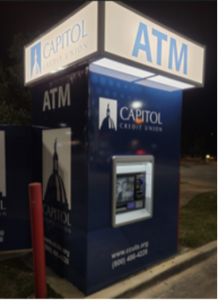
There is also a branding dimension that many institutions may overlook. Gandolfi said the machines Capitol Credit Union is using are typically placed in kiosks about 10 feet tall and wrapped in the credit union’s branding, effectively creating a large visual marker in a market where the institution may otherwise be invisible.
“They also have a huge advertising impact — eyeballs are really what you’re driving for here,” he said, noting that the units can help support checking account penetration in targeted geographies.
No Huge Capital Expense
And unlike a full branch project, the model doesn’t necessarily require a large capital outlay from the credit union. Gandolfi said Dolphin’s program is “lock, stock and barrel,” with Dolphin handling the capital expense, processing, service, armored transport and maintenance in exchange for a fixed monthly fee, while the credit union receives surcharge and interchange rebates that can help offset costs.
For credit unions wrestling with how to grow in fast-moving markets without overextending, Capitol Credit Union’s model offers a practical framework: use a deposit-capable access point not merely to serve members, but to gather proof. Are members using it? Are they depositing meaningful dollars there? Does the site sit in the flow of everyday life? Does it create enough visibility to build brand presence before the first wall goes up?
In Austin, Cardenas believes the answer is increasingly yes.
“How many do we want to put out there?” he said. “As many as we can because we’re finding them incredibly valuable.”
Contact your GoWest Solutions Team to discover how Dolphin Debit Access can help strengthen your credit union’s ATM/ITM outsourcing strategy.
Posted in GoWest Solutions, Top Headlines.














Brittanie Bonanzino
AVP, Communications
Washington
Phone: 509.218.1192
Toll-free: 800.995.9064

Alyse Knudsen
Manager, Communications
Oregon
Phone: 971.450.5660
Toll-free: 800.995.9064

Madlynn Schreibvogel
VP, Public Relations
Colorado
Phone: 303.513.3765
Toll-free: 800.995.9064