
Resilient at the Register — Strong Spending Despite Waning Confidence
October 21, 2026

By Velera
In the October edition of the Velera Payments Index, we saw that consumer spending remained strong, despite weakening confidence, rising inflation and ongoing affordability concerns.
Consumer confidence indicators declined in September. The Consumer Confidence Index score fell 6.7 points to 81.9, reaching its lowest level in more than a decade. The University of Michigan Index of Consumer Sentiment results fell to 48.1 from 51.7 in August, reaching its lowest level in four months.
Key Takeaways
Despite financial pressure, consumers continued to spend – largely on essential items. Key takeaways from the October edition of the Payments Index included:
- Debit purchases surged 9.5% year over year and credit purchases rose 6% in September.
- Purchase growth for both payment types continued to be driven by the Goods sector, and Gasoline remained a key driver amid elevated fuel prices.
- Debit non-discretionary purchases rose 9.6% year over year versus 8.6% for discretionary.
- Credit nondiscretionary purchases were up 6.7% compared with 2.8% for discretionary.
- Wage growth trailed inflation, while unemployment edged up to 4.2%.
“The disconnect between consumer sentiment and spending continues to widen,” said Norm Patrick, VP of Payments & Deposits Consulting at Advisors Plus, a Velera company. “We continue to see a shift in how and where consumers spend, with everyday essentials accounting for a larger share of growth, while digital payment methods are becoming even more ingrained in daily life. As consumers look for value and convenience, credit unions have an opportunity to strengthen relationships by making sure their cards remain the preferred choice wherever members choose to pay.”
Quarterly Metrics Update
The October edition of the Payments Index also features a quarterly metrics update, including:
-
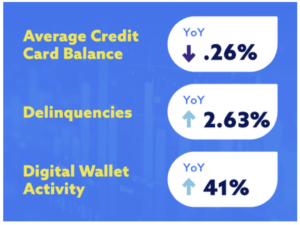
Credit Card Balances: The average credit card balance decreased $8, or 0.26%, year over year to $2,951, while total credit card balances fell 0.9%. The modest declines suggest cardholders are maintaining relatively steady balances despite ongoing pressures from higher household costs.
-
Delinquencies: Credit card delinquencies slightly increased in September, but remained in line with typical seasonal patterns and historical trends. The delinquency rate rose to 2.63%, up nine basis points (3.5%) year over year. Delinquency rates remained higher among younger generations, led by Gen Z at 4.4% and Millennials at 3.4%, compared with 2.4% for Gen X and 1.8% for Boomers.
- Digital Wallet Activity: Debit remained the primary driver of digital wallet growth, with transactions increasing 41% year over year compared to 37% for credit. Digital wallets now account for 14.7% of all debit transactions and 8.5% of credit transactions, with debit’s deeper penetration reinforcing its role as a key driver of adoption. Digital wallets have evolved into a more significant payment channel, as seen by the robust growth and expanding payment penetration.
More in-depth insights into Velera’s quarterly metrics update can be found by downloading the October 2026 Payments Index.
What Should Credit Unions Do Now?
Credit unions should consider the following strategies to maintain relevance, maximize engagement and best support their members:
- Strengthen digital wallet positioning to capture everyday spend. Securing top-of wallet status helps capture everyday spend and deepens cardholder engagement. Credit unions should focus on driving digital wallet enrollment and usage through targeted marketing, cardholder education and wallet-friendly rewards strategies. Explore how Velera’s digital wallet solutions help credit unions seamlessly provision cards into leading wallet platforms, supporting adoption, increasing transaction volume and keeping their cards top-of-wallet.
- Enhance card portfolio performance with post-holiday balance transfers. Post-holiday balance transfers can give members greater flexibility to manage high-interest debt, while supporting card portfolio performance. Credit unions should initiate campaign development now to ensure that their competitive, low-rate offers are in market when members begin seeking relief from holiday debt. Maximize results by making transfers simple and accessible through digital channels, convenience checks and phone support. Discover how Velera’s Marketing Engagement Platform makes it easy to launch and manage customized, targeted, multichannel campaigns.
- Prevent spend migration through proactive retention. Consumers can shift everyday spending to other cards without closing an account, making declining card usage an important early indicator of potential spend migration. Credit unions should leverage predictive analytics to identify changing behaviors and act sooner with personalized retention strategies. See how Velera’s predictive marketing solution provides data-driven insights to inform targeted offers, such as bonus rewards, credit line increases or more competitive rewards rates, helping retain spend, strengthen member relationships and improve portfolio profitability.
Looking Ahead
The next Federal Open Market Committee (FOMC) meeting will convene on Oct. 27-28. The Federal Reserve is widely expected to pause its tightening schedule and hold the federal funds rate steady at its current range of 3.75% to 4.00%. Inflation data from September likely strengthens the case for one additional rate hike before year-end, with the market expecting this to happen during the December meeting.
To learn more about Velera and the solutions they offer, connect with the GoWest Solutions Team today.
Posted in GoWest Solutions, Top Headlines.


















Brittanie Bonanzino
AVP, Communications
Washington
Phone: 509.218.1192
Toll-free: 800.995.9064

Alyse Knudsen
Manager, Communications
Oregon
Phone: 971.450.5660
Toll-free: 800.995.9064

Madlynn Schreibvogel
VP, Public Relations
Colorado
Phone: 303.513.3765
Toll-free: 800.995.9064