
Assume Good Intent: Managing Change from a Personal Standpoint or Leadership Role
June 24, 2026

By Tom Olney, VP, Organizational Development, Velera
Many years ago, before I had children, I used to say, “Nobody likes change, except babies.” But, after I had babies, I realized they don’t like change either! And if you’re like most, you’d prefer a certain amount of predictability in the work that you do and in most aspects of your life, too.
When we face change, we typically have a predictable reaction, adeptly illustrated by the familiar Kübler-Ross model:
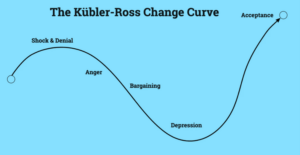
As you can see – and as you’ve likely experienced when some change occurred in your own life – the initial reaction to change is negative: Shock and Denial, moving quickly into Anger. Then comes Bargaining and Depression well before moving into the Acceptance phase and our ability to adapt and move on.
From major life changes (illness, death, divorce) to professional upheavals (mergers, job loss, reorganizations, process changes) to positive events (college graduation, new job, marriage, birth of a child), change can cause disruption in the lives of those affected. But change is inevitable: Indeed, since the days of Herodotus, “The only constant is change.” So, instead of reacting with resistance – or instituting change without considering the resistance of others – we can do some prep work ahead of time to acknowledge the impact and move through the process with less discomfort.
With this in mind, let’s take a look at change from a workplace perspective.
- First, for those affected by change, how can we improve our resilience?
- And second, for leaders, how can we prepare our teams for change so that the negative effects are minimal or at least manageable?
Preparing for the Inevitable
To understand why we respond to change as we do, here’s a quick review of how our brains process information. Note: We’re going to get a little “science-y” – but stick with it … it’ll be worth it!
When we receive information from our five senses (see, hear, touch, smell, taste), the three main parts of our brain work together:
- Autonomic (breathing, digestion, heartbeat), which includes the sympathetic nervous system – often referred to the “fight or flight” system that prepares the body for stress by increasing heart rate, dilating airways and redirecting blood flow to muscles.
- Limbic (memory, motivation, behavior) or the “emotional brain,” which plays a central role in processing emotions, survival instincts and social behaviors.
- Cognitive (logic, learning, decision making, language and reasoning), which enables humans to process information and adapt to their environment.
Here’s the tricky part: When input arrives, it travels through the autonomic and limbic systems BEFORE reaching your cognitive brain. That’s significant because the path first affects the basic involuntary processes that are essential for survival, add emotion and memory, and can even trigger a “fight or flight” reaction before logic kicks in.
So, when management calls an impromptu meeting to announce a sudden organizational change, your heart starts pounding, fear grips your chest and emotion drowns out whatever message leadership came to deliver.
With this knowledge about how your brain works, instead of change immediately derailing you, you can make a conscious choice toward resilience in the face of change. Realize that the initial reaction may not be helpful, especially in a professional setting – and instead of bowing to the emotional reaction, take control.
- Treat your gut reaction as a “first draft” – knowing that the information passes through your emotions before reaching your logical mind.
- Be present. Take a moment to reflect and be present in the moment. Ask, “What is really happening here?” before reacting.
- Change your environment or clear your mind with self-care. Then come back to the issue after the initial reaction has passed.
- Talk it out. For perspective, talk with a trusted friend or colleague, someone not directly affected by the issue.
- Write it down. If journaling helps, grab a notebook and write it down to help make sense of the situation.
Each of these options can help you step back from the initial, often exaggerated response and allow your logical brain time to process. In addition to minimizing the discomfort of change, taking control of your response can also prevent inappropriate reactions that may disrupt the situation further and damage important relationships.
Leading the Way
As the leader of a team – be it a project team, a teller line or an entire organization – you face big challenges with change. Whether you are the instigator or merely instituting a mandate from above, YOU are the figurehead of change – the one responsible for making others go through a potentially uncomfortable experience.
Long-term adoption and ultimate success rely on your ability to lead – and you can ease the discomfort and minimize resistance with some preparation and transparency, taking into account the needs of the people affected by the change.
Determine what the change is and the impact on those who will be affected. Give it a name, a description and a scope. “The upgraded software, called Gorgon 2.0, is going to combine three different applications you’re using now into one simplified user interface. Training will be provided next month, and we’ll have two more months to learn it before we cut over and Gorgon 2.0 is used exclusively.”
Next step: Claim It!
Show your support for the new direction in a convincing and credible way. “I know that you all just learned Gorgon 1.0 last year, so I was a bit peeved that we have to go through that again. But when I saw that the developers took our input into their design and that several of our biggest gripes were addressed, I felt a lot more positive about it.”
Last step: Aim It!
Put a plan together with those who are most directly impacted. Look for allies. “In today’s team meeting, I’m going to discuss the plan that I’ve pulled together with the help of our senior reps to help us learn, adopt and successfully transition to Gorgon 2.0. We’ve created some learning aids, adapting what came from the vendor to our specific work. As we learn, we’ll also pull together periodically to see what’s working and what’s not, and share best practices so we can all get proficient as quickly as possible.”
Change Can Be Good!
Effectively managing change requires support of leaders from the top down. If you are the one instituting the change, consider creating a change charter that outlines the purpose of the change (why it’s being done), the solution proposed (what is being done), the population and systems affected (scope of the change), and the key stakeholders (who’s in charge). It’s also helpful to include a high-level proposed timeline and some of the known constraints and potential risks.
Change will always be challenging, but managing change – from a personal standpoint or a leadership role – can shift the experience into a more positive light. Overall, assume good intent: That the change has been well considered and will, in the end, produce positive results.
To learn more about Velera and the solutions they offer, connect with the GoWest Solutions Team today.
About the Author: As Vice President of Organizational Development, Tom Olney oversees Velera’s employee and leadership development programs. He also partners with Advisors Plus to offer organizational effectiveness workshops, succession planning, Organizational Change Management (OCM) consulting and support, coaching and customized team development workshops to financial institutions. Tom is passionate about helping leaders at all levels achieve better results through people; and he loves building coalitions to complete difficult projects, delighting the client, deepening relationships and leveraging emerging technology for creative solutions. He is a graduate of the University of Central Florida, with a Masters of Science, Industrial Organizational Psychology, and has more than four decades’ experience in Organizational Development, Project Management, OCM and Knowledge Management.
Posted in GoWest Solutions, Top Headlines.


















Brittanie Bonanzino
AVP, Communications
Washington
Phone: 509.218.1192
Toll-free: 800.995.9064

Alyse Knudsen
Manager, Communications
Oregon
Phone: 971.450.5660
Toll-free: 800.995.9064

Madlynn Schreibvogel
VP, Public Relations
Colorado
Phone: 303.513.3765
Toll-free: 800.995.9064