
How Credit Unions Can Put Oregon’s Latest Financial Data to Work for Members
Posted by Alyse Knudsen on March 25, 2026
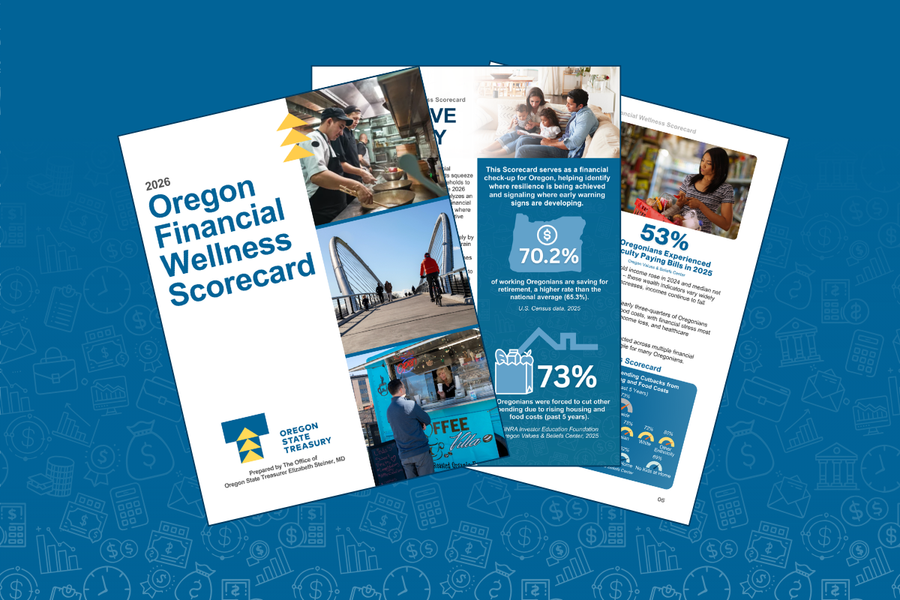
Nearly three-quarters of Oregonians are feeling increasing cost of living pressures, contributing to record household debt and a 25% jump in bankruptcy filings in 2025. Those are among the takeaways from the 2026 Oregon Financial Wellness Scorecard, which spotlights key economic and personal finance trends across the state.
The state’s annual financial check-up shows a mix of economic signals. Median household income increased, yet the rate of emergency savings remains concerningly low, with 48% of Oregonians unable to cover a $500 emergency expense with their savings, and systemic barriers continuing to make it harder for many people to get ahead.
“Many Oregonians are struggling with rising prices for food, housing, and health care. Federal tariffs and funding cuts have forced households to absorb new costs, disrupted businesses, and hurt jobs in Oregon,” Oregon State Treasurer Elizabeth Steiner, MD, said. “While it’s harder to make ends meet, we can all take steps to improve our financial fitness.”
The 2026 Scorecard includes a Financial Fitness Check-up to help Oregonians improve their long-term financial security. The Check-up highlights small steps Oregonians can take that will lead to big changes in their financial health, such as taking advantage of incentives to save for college or career training, or making sure you have a small emergency fund.
2026 Scorecard Highlights
- A majority of families, with (63%) and without children (56%), said in 2025 it is difficult make ends meet each month;
- Median household income climbed to $85,220 statewide in 2024, but it was less in rural counties and for Black ($66,756), Hispanic ($78,442) and Native American/Alaskan ($63,278) households; About a third of Oregonians (35%) said they can’t afford to save every month;
- More Oregonians said they completed a financial education program in 2025 (56%), compared to 2023 (51%); and
- Oregonians reported $126 million in fraud losses in 2024 to the U.S. Federal Trade Commission, and the number of consumer complaints to the Oregon Department of Justice rose by 50% from 2023 to 2024.
How Credit Unions Can Put the Scorecard to Work
For Ashley Wilson, Community Education Director at Oregon State Credit Union and member of the Financial Empowerment Advisory Team, the Financial Wellness Scorecard is more than a snapshot of trends — it’s a practical tool credit unions can use to better support their members.
“The report offers valuable insight into state-level trends affecting consumers across Oregon,” Wilson said. “Credit unions can use this information to better understand the needs of Oregonians and identify supports they may be able to offer in response.”
That understanding can help credit unions lead with greater empathy, particularly as many households continue to feel the impact of rising costs. The data not only highlights challenges but also helps normalize the experiences many members are facing.
“At the member level, the findings can be reassuring by helping people see that they are not alone in what they are experiencing,” she said.
Wilson also noted that the scorecard provides an opportunity to enhance everyday member interactions. At Oregon State Credit Union, “we are using the scorecard as a lens to help our teams better understand the current financial climate for our members,” Wilson shared. By incorporating simple, relevant questions from the report into conversations, staff can create more thoughtful, informed discussions about financial wellbeing and next steps.
Beyond member-facing roles, the scorecard can also guide internal strategy. “It provides shared context for decision-making, program design, communications, and operational planning,” Wilson added, “by grounding that work in the real financial experiences of Oregonians.”
By using the scorecard in both conversations and planning, credit unions can more closely align their efforts with the needs of the communities they serve.
About the Data
The Scorecard compiles data and benchmarks from state and federal sources including the Federal Reserve, U.S. Census and a public interest survey by the Oregon Values and Beliefs Center. The wide-ranging analysis is guided by the Oregon Financial Empowerment Advisory Team, a public-private partnership chaired by Oregon State Treasurer Elizabeth Steiner, MD.
Complied to help the public and decisionmakers better understand how well Oregonians are faring financially, the Scorecard also tracks how household situations, education, resiliency, and consumer protection trends differ across the state.
First released in 2023, Oregon’s Financial Wellness Scorecard has been cited Denver-based National Endowment for Financial Education as an innovative national model.
“The scorecard tells us where there are opportunities to permanently disrupt poverty and change economic trajectory,” said Scott Cooper, Executive Director of Redmond-based nonprofit NeighborImpact and a member of the Financial Empowerment Advisory Team. “We know plenty about how to deal with symptoms of poverty and economic struggle, but this gives us in an insight into where interventions might work.”
He said today’s struggles reflect what nonprofits are seeing in Central Oregon. “Every human service nonprofit in the region is seeing surging demand for food, affordable housing, and help with energy and childcare,” Cooper said. “The affordability crisis is real.”
The scorecard is available through the Treasurer’s Financially Fit Oregon resource page, at FinanciallyFitOregon.org. The site makes it easy to connect with the array of financial education and consumer resources offered by partner state agencies, plus a community calendar of financial wellness classes and events from trusted partners.
Posted in Community Impact, Oregon, Public Awareness, Regional Member News, Small Credit Unions, Thought Leadership, Top Headlines.














Brittanie Bonanzino
AVP, Communications
Washington
Phone: 509.218.1192
Toll-free: 800.995.9064

Alyse Knudsen
Manager, Communications
Oregon
Phone: 971.450.5660
Toll-free: 800.995.9064

Madlynn Schreibvogel
VP, Public Relations
Colorado
Phone: 303.513.3765
Toll-free: 800.995.9064