
2026 Oregon Legislative Session Adjourns
Posted by Pam Leavitt on March 8, 2026
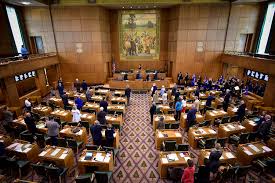
The 2026 Oregon legislative “short” session ran from Feb. 2nd to March 6th and focused on shoring up the state budget, housing and transportation, while advancing several consumer protection and civil rights measures.
Lawmakers met for just over a month, convening Feb. 2 and adjourning sine die on March 6, 2026. Facing a budget gap of roughly $300 million at the Oregon Department of Transportation plus broader revenue pressure, they closed much of the shortfall by leaving state positions vacant, trimming agency supply budgets, and redirecting transportation funds, while avoiding large cuts to K 12 schools and higher education.
Your GoWest Credit Union Association tracked several bills of interest to Oregon credit unions. We will be providing a summary in our post session report. We want to thank the over 125 credit union advocates who made their way to Salem for our biennial Legislative Luncheon and Capitol Visits. The day was highlighted by a presentation from our Attorney General Dan Rayfield.
Next year for the 2027 session, we will be back to the longer schedule with all-day afternoon appointments during Credit Union Day at the Capitol.
Here are some of the major highlights of the 2027 session:
Housing and land use
• A key housing bill backed by the Governor, House Bill 4082, passed with strong bipartisan support and allows cities to bypass some land use rules to speed development of senior and manufactured housing, with the goal of adding hundreds of affordable units and easing pressure on the wider market.
• Another bill, HB4128 gives homebuyers a 90-day priority window before large investors can purchase single family homes.
Transportation and Moda Center
• To stabilize ODOT operations after previous transportation revenues were frozen pending a ballot measure, legislators used vacancies and federal funds to cover about half of the roughly $300 million hole, then shifted money from safety, bridge retrofit, rail, and vehicle electrification programs to fill the rest.
• Senate Bill 1501 authorizes significant public support—about $365 million in borrowing—to renovate Portland’s Moda Center and secure the long term future of the Trail Blazers, using arena related revenues and existing funding mechanisms rather than new taxes.
• One of the most controversial bills was the passage of SB 1599–mostly along party lines (a handful of Democrats voted no). This bill moves the gas tax and fee hike referendum from the November general election ballot to the May primary ballot. A referendum, signed by over 250,000 Oregonians, specifically stating that they were requesting a vote on November’s general election ballot. The bill passage goes beyond the date stated by Secretary of State Tobias Reed as the workable date to get it on May’s primary election ballot without compromising the ability for voters to adequately qualify their arguments in favor/opposition of the referendum, leaving the actual delay in jeopardy. And as promised by citizens and chief petitioners, several lawsuits have been filed that seek an injunction to block SB 1599.
Consumer and local government bills
• Lawmakers “ended the practice of predatory lending” by closing a loophole that allowed extremely high interest loans and also cracked down on hidden ticket resale fees, according to majority leaders highlighting bipartisan consumer protection wins.
• HB 4116 – Consumer finance loans “opt out” bill declares that Oregon does not want the federal amendments in section 521 of the Depository Institutions Deregulation and Monetary Control Act of 1980 (DIDMCA) to apply to consumer finance loans made in the state. Practical effect: This kind of “opt out” is aimed at preserving Oregon’s state level limits and rules on interest rates and terms, rather than letting certain lenders rely on more permissive federal preemption under DIDMCA.
• The LOCAL Act, House Bill 4148, lets cities spend up to 50% of local lodging tax revenues on general local government purposes instead of requiring 70% to go to tourism promotion, giving cities more budget flexibility but drawing opposition from tourism interests.
Credit union advocates will be quickly be moving into the 2026 election cycle as “filing day,” the day candidates must declare for our May Primary election must file for office. GoWest will be on the House floor this Tuesday watching for any surprises with the announcement of candidates!
Posted in Advocacy on the Move, Oregon Advocacy.














Brittanie Bonanzino
AVP, Communications
Washington
Phone: 509.218.1192
Toll-free: 800.995.9064

Alyse Knudsen
Manager, Communications
Oregon
Phone: 971.450.5660
Toll-free: 800.995.9064

Madlynn Schreibvogel
VP, Public Relations
Colorado
Phone: 303.513.3765
Toll-free: 800.995.9064