
From Sponsorship to Experience: How WECU Turned a County Fair Presence into a Financial Education Adventure
Posted by Alyse Knudsen on August 13, 2026
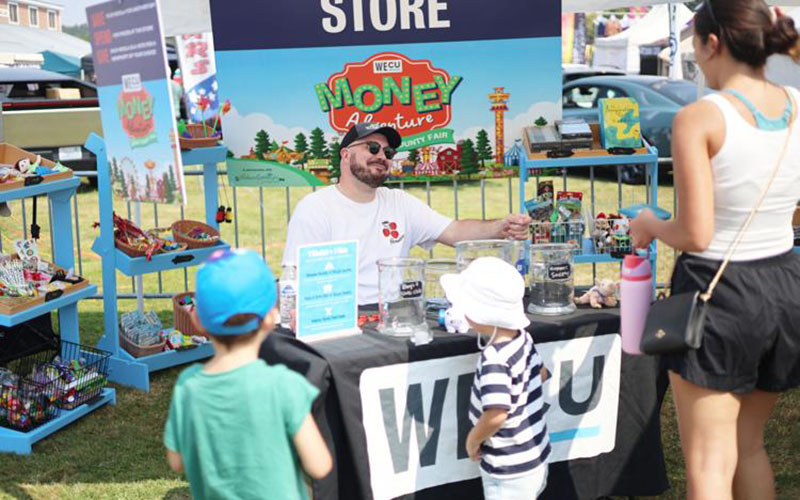
WECU could have done what brands have done at fairs for decades: put up a tent, hand out some swag and wait for people to walk by.
Instead, the credit union asked a different question: What could we create that would make the fair better?
That question became WECU Money Adventure, a four-day interactive experience at the 2026 Skagit County Fair in Washington that combined financial education, community giving, and brand engagement into one kid-focused activation.
The result was more than 800 kids participating, more than 4,000 pieces of WECU’s custom “Moola” currency distributed and more than 1,400 prizes purchased at the Money Adventure store.
For WECU, the activation offered a different approach to event sponsorship: rather than treating the sponsorship and the experience as separate pieces, build an experience that makes the sponsorship itself more valuable.
“We wanted to show up at the fair, but we didn’t want to just show up,” said Keith Mader, WECU Director of Public Relations and Communications. “We wanted to create something that people would actually seek out and remember. If we could use that experience to teach kids about money and giving back at the same time, even better.”
 Start with the experience, not the logo.
WECU developed the Money Adventure concept around four basic financial ideas: earn, save, spend and give.
The Children’s Museum of Skagit County became a natural partner. The museum brought its expertise in creating hands-on educational experiences for children and turned WECU’s concepts into fair-themed activities.
When children arrived at the Money Adventure Zone, they received a small WECU wallet printed with three words: Save. Spend. Give.
Then they got to work.
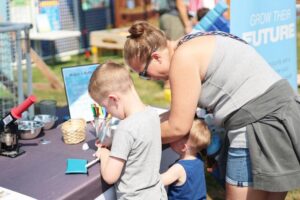
Six Adventure Stops inside the WECU area gave kids opportunities to earn Moola through activities including piggy bank races, estimating the number of eggs in jars, a carnival-style slingshot game, searching through corn for coins that added up to $1 and tossing balls into milk jugs.
The experience was designed to make earning money feel tangible.
Kids could then take their Moola to the Money Adventure store, where they made their own spending decisions. Prizes included sticky hands, bouncy balls, candy, piggy banks, board games, and more.
The Children’s Museum supplied much of the prize inventory, creating a selection that kept kids coming back.
“The museum really knows kids,” Mader said. “We knew we wanted a store, but they took it to another level. The variety of prizes made the whole thing feel like a real experience for the kids.”
The approach also aligned with how children actually begin developing financial skills. The Consumer Financial Protection Bureau notes that foundational financial attitudes and skills begin developing in early childhood, while financial habits and norms take shape during middle childhood. Its youth financial education guidance emphasizes hands-on, age-appropriate activities as a way to help children build those skills.
Money Adventure essentially turned those principles into a fairground game.
Use the activation to move people — not just attract them
One of the most strategic elements of Money Adventure was that not every Adventure Stop was located inside WECU’s footprint.
Three additional stops were spread across the fairgrounds at the petting zoo, Birds of Prey exhibit, and model train display.
Kids and their families had to explore those areas to complete trivia challenges based on what they saw.
The stops served two purposes.
First, they made the experience more adventurous for kids. Second, from a marketing perspective, they extended WECU’s presence beyond its primary activation area.
That was intentional.
WECU wanted to drive families to its Money Adventure Zone, where the credit union could engage directly with them. But the additional stops allowed the brand to become part of the broader fair experience rather than remaining confined to a single booth.
It was one piece of a larger visibility strategy.
During the fair, WECU was visible at both fair entrances, at three additional high-traffic locations, in the fair program, in advertising, and on social media. WECU also had a representative speak on the main stage mic at one point.
Two WECU employees staffed the Money Adventure experience throughout the fair.
The goal wasn’t simply to maximize impressions. It was to maximize reasons to engage.
Give people something to do
That distinction is at the heart of the strategy.
A traditional sponsorship can put a brand in front of thousands of people. But visibility doesn’t necessarily create interaction.
Money Adventure gave families a reason to stop. Then it gave them a reason to stay. Then it gave them a reason to explore.
And, importantly, it gave them a reason to come back to the WECU area after visiting other parts of the fair.
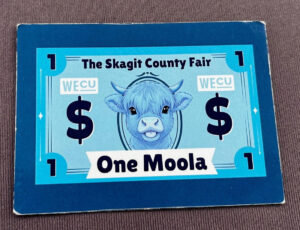 The Moola economy created a natural engagement loop:
Earn Moola → return to the zone → make a spending decision → play again → earn more → choose what to do with it.
More than 800 kids received wallets during the four-day fair. More than 4,000 Moola were distributed, and more than 1,400 prizes were purchased.
The experience also generated moments that no static sponsorship could have created.
A group of 4-H kids who were at the fair throughout the week pooled their Moola together to purchase a collection of sticky hands. Their plan was to tie them together and attempt to create the “biggest sticky hand in the world.”
For a credit union trying to create meaningful engagement, that’s a pretty good outcome.
“We had kids who were showing goats, sheep, and pigs and then coming over to earn Moola,” Mader said. “They were making decisions about money, but they were also just having fun. That’s what made it work.”
Add a purpose beyond the brand
The final piece of the experience was giving.
Kids could use their Moola to vote for one of three local nonprofits: Humane Society of Skagit County, Boys & Girls Clubs of Skagit County, or Helping Hands Food Bank.
WECU committed to donating $1,000 to the nonprofit receiving the most votes, and the vote was remarkably close.
Helping Hands received 262 votes. The Humane Society received 241, while Boys & Girls Clubs received 239.
The result gave children one more financial decision to make — and connected their individual choices to a community outcome.
“Giving was important to us because we didn’t want the whole experience to be about getting a prize,” Mader said. “We wanted kids to understand that money can do something for someone else, too.”
A different way to think about sponsorship
For WECU, Money Adventure wasn’t designed as a one-size-fits-all sponsorship model. It was designed specifically around the Skagit County Fair, WECU’s goals, and the community it wanted to reach.
But the underlying strategy is transferable.
Instead of asking “How much exposure does our sponsorship buy?”, WECU approached the opportunity by asking: “What can we create that people will want to participate in?”
That shift changed how the brand showed up at the fair.
The sponsorship became an experience.
The experience became financial education.
The financial education became a reason to engage with WECU.
And the engagement ultimately became an opportunity to give back to the community.
For WECU, that is the bigger lesson from Money Adventure.
“Being a credit union means we’re member-owned and not-for-profit,” Mader said. “We think that should look different in the community. We don’t want to just put our name on something. We want to invest in the places where our members live and make the communities we’re part of better.”
At the Skagit County Fair, that meant giving kids a wallet, a handful of Moola and a reason to go on an adventure.
And, perhaps without realizing it, giving them a few of their first lessons about money along the way.
Posted in Financial Education, Regional Member News, Washington.













Brittanie Bonanzino
AVP, Communications
Washington
Phone: 509.218.1192
Toll-free: 800.995.9064

Alyse Knudsen
Manager, Communications
Oregon
Phone: 971.450.5660
Toll-free: 800.995.9064

Madlynn Schreibvogel
VP, Public Relations
Colorado
Phone: 303.513.3765
Toll-free: 800.995.9064